Decoupling the Yield-Quality Paradox in Wheat through Integrated Rhizospheric Bio-Priming with NPK Consortia
Avinash Kumar Rai
Krishi Vigyan Kendra, Ghazipur, Directorate of Extension, Aacharya Narendra Dev University of Agriculture & Technology, Kumarganj, Ayodhya, UP, India.
Apurba Pal *
Department of Plant Physiology, Bihar Agricultural University, Sabour, Bhagalpur, Bihar-813210, India.
Tushar Sinha
Genetics and Plant Breeding, Sam Higginbottom University of Agriculture Technology and Science,Prayagraj, Uttar Pradesh, India.
Sulochna
Department of Agronomy, Faculty of Agriculture, Agriculture College Garhwa, Bishunpur, Piprakala, Garhwa-822114, Birsa Agricultural University, Jharkhand, India.
Sathya Thirumurugan
Department of Entomology, GIET University, Odisha, India.
Sumit Raj
Department of Soil Conservation and Water Management, CSAUA&T, Kanpur-0, India.
Narinder Panotra
Institute of Biotechnology, SKUAST Jammu, J&K -180009, India.
Ravi Shankar Pandey
Krishi Vigyan Kendra- Basti (ANDUA&T, Kumarganj, Ayodhya, U.P.), India.
*Author to whom correspondence should be addressed.
Abstract
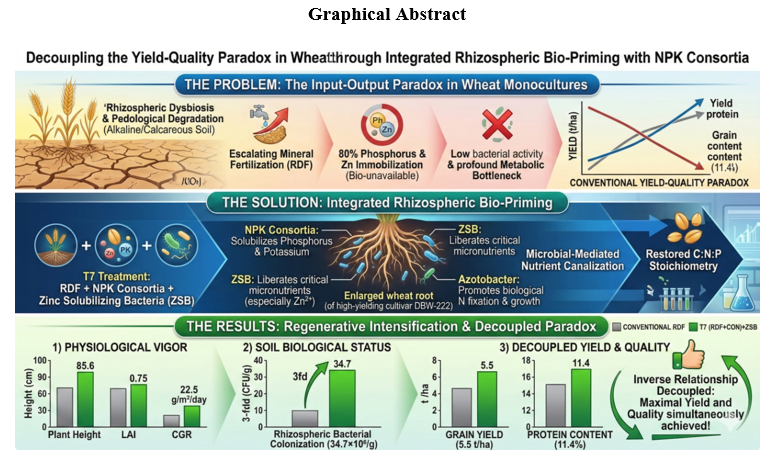
The intensification of wheat (Triticum aestivum L.) monocultures in the Indo-Gangetic Plains has precipitated a precarious "input-output" paradox, wherein escalating mineral fertilisation induces rhizospheric dysbiosis and severe pedological degradation. In these alkaline, calcareous landscapes, chemical immobilisation renders upwards of 80% of applied phosphorus and critical micronutrients, specifically Zinc (Zn2+), bio-unavailable, creating a profound metabolic bottleneck. This study interrogates the hypothesis that transitioning toward Microbial-Mediated Nutrient Canalisation via tripartite bio-inoculants can decouple productivity from environmental exhaustion. A field investigation was executed during the Rabi season of 2024 at KVK, Ghazipur, utilising a Randomised Block Design (RBD) with three replications. The high-yielding cultivar DBW-222 was subjected to seven nutritional configurations, integrating Recommended Dose of Fertilisers (RDF) with diazotrophic Azotobacter, specialised NPK Consortia, and Zinc Solubilising Bacteria (ZSB). Physiological growth kinetics (Plant Height, LAI, CGR), grain proteomic stoichiometry (modified micro-Kjeldahl), and post-harvest edaphic biological status (CFU analysis) were rigorously quantified. Empirical outcomes elucidated a significant hierarchical progression (T7 > T6 > T4 > T3 > T5 > T2 > T1), with Treatment T7 (RDF + NPK Consortia + ZSB) achieving maximal vegetative vigour: plant height (85.6 cm), LAI (0.75), and CGR (22.5 g/m2/day). Notably, T7 demonstrated a superior qualitative profile with Protein Content peaking at 11.4%, effectively decoupling the typical inverse relationship between yield and quality. Economic productivity reached its zenith in T7 with a Grain Yield of 5.5 t/ha, underpinned by a three-fold increase in rhizospheric bacterial colonisation (34.7 times 106 CFU/g) over the control. The integration of multimodal microbial consortia with mineral regimes mitigates the "biological void" left by conventional fertilisation, restoring soil ecological functionality. The synergistic interaction between NPK-mobilizers and ZSB optimises the Carbon-Nitrogen-Phosphorus (C: N:P) stoichiometry, offering a mechanistic framework for regenerative intensification in high-input agrosystems.
Keywords: Rhizospheric dysbiosis, Microbial-Mediated Nutrient Canalisation, stoichiometric optimisation, Triticum aestivum, zinc solubilization, regenerative intensification