Advances in Green Synthesis of Nanoparticles from Crop Residues and Their Application in Sustainable Agriculture: A Review
Agus Wedi Pratama *
Department of Agrotechnology, Faculty of Agriculture, University of Jember, Jalan Kalimantan Tegalboto 37 Jember, Indonesia.
*Author to whom correspondence should be addressed.
Abstract
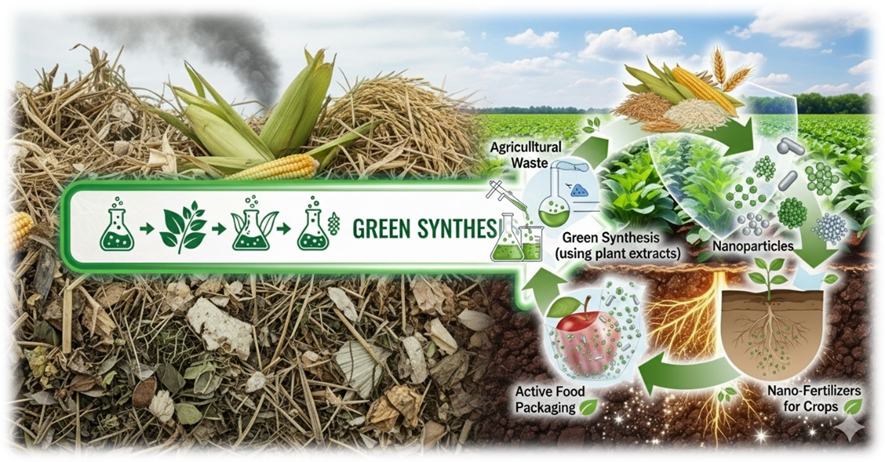
The vast abundance of crop residues, amounting to millions of tonnes annually, remains a largely underutilized resource, underscoring the urgent need for sustainable valorization strategies. This review provides a comprehensive evaluation of the green synthesis and application of nanoparticles derived from a wide range of crop residues, including leaves, husks, straw, bagasse, and seeds. We explore the efficacy of various green pre-treatment methods—such as the use of organosolvents, steam explosion, and deep eutectic solvents—for their potential to enhance nanoparticle yield while minimizing energy consumption and aligning with the principles of green chemistry. The applications of these crop residue-derived nanoparticles (CRNs) are extensive, spanning critical sectors such as sustainable agriculture, where they are used to improve crop protection, enhance nutrient delivery, and promote soil health. Special attention is given to their role in active food packaging and as controlled-release carriers for agrochemicals like fungicides and pesticides. While CRNs hold considerable promise, significant challenges related to the heterogeneity of raw materials, scalability of production, and potential nanotoxicity must be addressed to ensure consistent quality and safe application. This review synthesizes current research, highlights existing gaps, and emphasizes the critical role of CRNs in fostering a circular economy and supporting global sustainability goals.
Keywords: Waste valorization, nanoparticles, sustainable agriculture, food preservation