Current Trends and Future Perspectives in Treatment Strategies for Dye-Containing Textile Wastewater
Ambika Kumar *
Department of Chemistry, Bhagalpur National College, Bhagalpur, Pin-812007, (A Constituent Unit of T. M. B. U. Bhagalpur), Bihar, India.
*Author to whom correspondence should be addressed.
Abstract
Discharge of high quantities of colored and poisonous effluents emitted by the textile industries has imposed a life-threatening environmental threat. Such effluents are composed of recalcitrant synthetic dyes and heavy metals which increase biochemical and chemical oxygen demand, decrease dissolved oxygen, and eventually cause damage to aquatic ecosystems. Azo and anthraquinone dyes, especially, are not biodegradable and get deposited as dangerous pollutants. The present work is focused on a systematic review of various dye remediation technology reported in the articles mostly published since 2015. Scopus, Web of Science, and ScienceDirect resources were used to find literature, and specific keywords (photocatalysis, bioremediation, hybrid technology, nanotechnology, and advanced oxidation processes (AOPs), dye-laden textile effluents) were used to locate the literature in the databases. Several operational parameters and results were compared to determine technological performance. Extensive literature review on photocatalytic pollutant removal with UV/TiO2 and UV/ZnO, especially doped forms, shows a high time performance of 98 percentage of BOD/COD and 99 percentage of color/lignin removal. Azo bonds and aromatic rings are broken with the help of microbial and enzymatic treatments via bacteria, fungi, algae, and yeast, and key enzymes laccases, azoreductases, manganese peroxidases, and lignin peroxidases to cleave azo bonds, aromatic rings under mild, environmentally friendly conditions to achieve synergistic and sustainable decolorization and detoxification of textile dyes in wastewater. Recent studies advocate the implementation of hybrid and artificial intelligence (AI) based technologies to design more sustainable approach to address the issue. The review also emphasizes several comparative results to find out cost-effective, scalable, eco-friendly methods in line with the idea of the circular economy and the sustainability objectives of the contemporary textile industries.
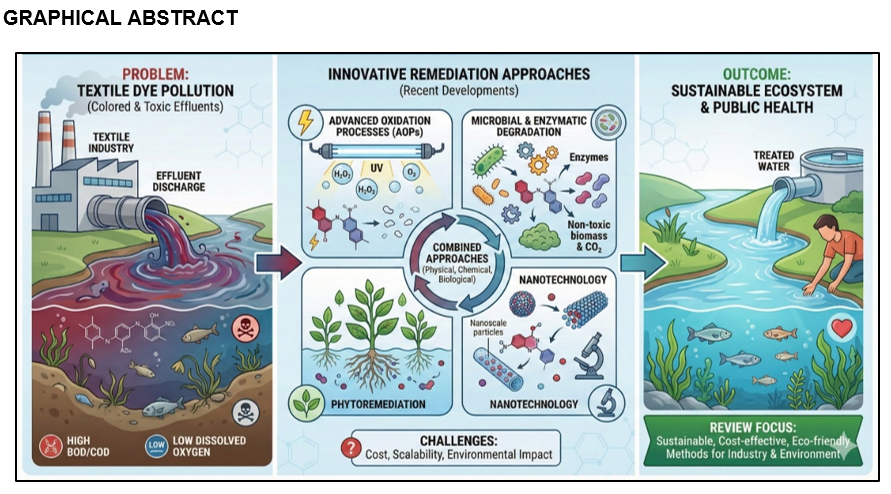
Textile dye pollution remediation: Recent advances and sustainable solutions (Image generated using Google Gemini AI for illustrative purposes)
Keywords: Textile pollution, synthetic dye, wastewater, toxicity, remediation techniques, hybrid technologies